

The Dow Jones Industrial Average closed the first week of July at a record high. The Nasdaq fell the same week. Both of those things are true, and the gap between them might be the most useful signal in markets right now.
Here is what happened: AI semiconductor stocks, the group that carried index returns for the past two years, gave some back. Micron reported strong earnings and dropped more than 10% int he first half alone.
The mechanism matters more than the headline. When a stock sells off on good news, the market is telling you that the good news was already in the price. Expectations had run ahead of anything the company could deliver. Macro investor Jordi Visser flagged the Micron move for exactly this reason, noting that "when you sell off on great news, that is not a good sign." He calls this a mid-cycle slowdown in the AI trade: the easy money in infrastructure names has been made, and real headwinds are accumulating, from data center permitting delays to competition from Chinese open-source models.
None of this means the AI buildout is over. Visser himself still projects a multi-decade expansion across memory, infrastructure, and robotics. The technology thesis and the valuation questions are two different questions. You can believe in the first and still be disciplined about the second.
Meanwhile, look where the money went—industrials, financials, healthcare. The unglamorous names trading at modest valuations pushed the Dow to record highs while tech consolidated. Market breadth, the share of stocks actually participating in advance, is finally widening
We have written repeatedly about narrow participation: a handful of mega-cap names driving index returns while the average stock went nowhere. That environment created a hidden problem. Investors who owned an S&P 500 index fund thought they were diversified when they really owned a concentrated bet on one theme. We called it "false diversification."
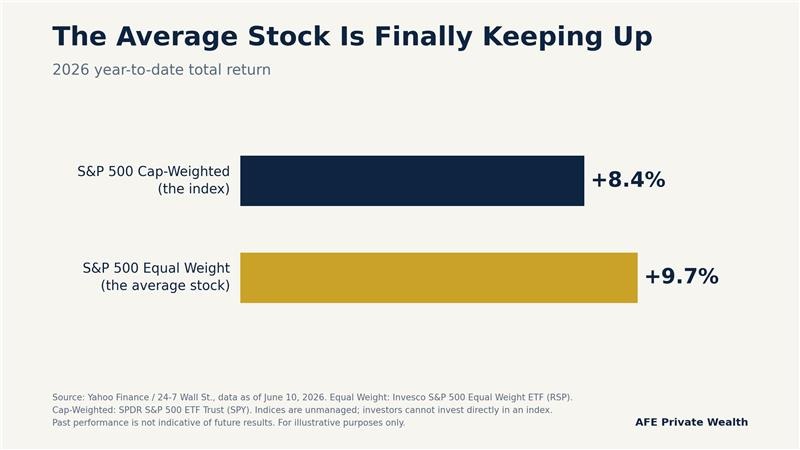
This rotation is the other side of that trade. For the first time in a while, owning things other than the AI leaders is getting paid.
What does that mean in practice? Not selling AI exposure wholesale and not chasing the Dow because it made a new high. It means the boring disciplines matter again: rebalancing back to targets, paying attention to what you are paying for growth, and owning genuinely different assets rather than ten versions of the same bet.
Markets reward fundamentals over time. They punish crowded expectations on their own schedule. The first week of July was a reminder of both.
Sources: CNBC market coverage (June 30, 2026); Zacks Investment Research market summary (July 6, 2026); Jordi Visser interview, The Pomp Podcast, as reported by Stocktwits/Yahoo Finance (July 5, 2026)
Disclosures
Advisory services offered through NewEdge Advisors, LLC, a registered investment adviser. AFE Private Wealth is a DBA of NewEdge Advisors, LLC. Registration with the SEC does not imply a certain level of skill or training.
This commentary is for informational and educational purposes only and does not constitute investment, legal, or tax advice, nor an offer or solicitation to buy or sell any security. The views expressed are those of the author as of the date of publication and are subject to change without notice. Third-party views referenced herein, including those of Jordi Visser, are provided for illustrative purposes and do not constitute an endorsement by AFE Private Wealth or NewEdge Advisors, LLC.
The Dow Jones Industrial Average, S&P 500, and Nasdaq Composite are unmanaged indices. Investors cannot invest directly in an index. Index performance does not reflect the deduction of fees or expenses. References to specific securities, including Micron Technology, are for illustrative purposes only and do not constitute a recommendation to buy, sell, or hold any security.
Past performance is not indicative of future results. All investing involves risk, including the possible loss of principal. Diversification and rebalancing do not guarantee a profit or protect against loss in declining markets. Forward-looking statements involve uncertainties, and actual results may differ materially. Investors should consult their financial, legal, and tax advisors regarding their individual circumstances.