

Every cycle has its own version of investment FOMO.
Sometimes it shows up in beaten-down travel stocks. Sometimes it shows up in video game retailers. Sometimes it shows up in tech, memory, semiconductors, AI infrastructure, or whatever sector gets blessed by the headline of the week.
The costume changes. The emotion does not. A stock starts moving. Then it moves a lot. Then everyone suddenly has a thesis.
→ Short interest was too high.
→ AI demand is exploding.
→ Storage is the new oil.
→The company was misunderstood.
→The market finally figured it out.
Maybe some of that is true. Maybe all is it is true. But that is not the real issue. The real issue is that most of these stories become obvious after the chart has already gone vertical. Hindsight takes a very complicated situation and makes it feel simple. The brain edits the movie. It removes the uncertainty, the false starts, the risk, the timing problem, and the dozen other socks that looked just as interesting but went nowhere.
That is the poison of FOMO. It makes luck look like a process. There will always be a stock going to the moon. There will always be a screenshot. There will always be a guy who turned a modest amount of money into a ridiculous amount of money and somehow found the humility to post about it immediately. That does not mean there is a reliable way to predict the next one. Sometimes, gambling works. That is why gambling survives. The occasional jackpot is not a bug in the system. It is the system. The win keeps people coming back. The near miss keeps them believing they are getting smarter. The story gets better right up until the money is gone.
This is where investing gets uncomfortable, because the truth has nuance. Concentration creates wealth. Diversification protects wealth. Most meaningful wealth was not created by owning a tiny slice of everything. It was created through concentrated effort. Concentrated risk in a company, career, practice, real estate deal, or entrepreneurial bet.
Early in life, that can make sense. You have time. You have energy. You have earning power ahead of you. Your biggest asset may not be your portfolio. It may be your ability to work, learn, build, sell, lead, and recover. At that stage, almost everything feels like a moonshot. In some ways, it should. You are supposed to bet on yourself. You are supposed to take intelligent risks. You are supposed to push. Otherwise, you follow the averages and end up, well, average.
Time changes the math. As wealth grows, the cost of a major mistake gets larger. More importantly, the time available to recover gets smaller. Losing big at 28 is painful. Losing big at 58 can permanently change the life you thought you had already earned.
That is when the boring stuff starts to matter. Not boring as in lazy. Not boring as in average. Not boring as in "hide in cash and hope inflation is polite."
→ Boring as in disciplined.
→ Boring as in tax aware.
→ Boring as in liquid enough to sleep.
→ Boring as in diversified enough that one bad decision does not get a vote over your entire future.
→ Boring as in financially independent.
And financial independence is not actually boring. It is just hard to turn into a viral screenshot. Nobody wants to post "I did a big thing, managed my taxes, owned a thoughtful portfolio, kept concentration where I had an actual edge, and avoided blowing myself up."
That does not get clicks. But it does create optionality. It lets you find the business. Buy the building. Take the trip. Help the kids. Walk away from a bad deal. Survive the cycle. Ignore the noise. Make decisions from strength instead of desperation.
The best wealth strategy is not to eliminate risk. That is impossible. The best strategy is to put risk where it belongs.
✓ If your edge is your business, press there.
✓ If your edge is your profession, build there.
✓ If your edge is relationships, lean into them.
✓ If your edge is tax strategy, planning, execution, and patience, compound that.
But pretending your edge is guessing the next stock to explode because you read three posts and watched the price move is usually not a strategy. It is entertainment with a brokerage account. And when the left side of a chart looks like the Eiffel Tower... More often than not, the right side will too as it comes down to Earth.
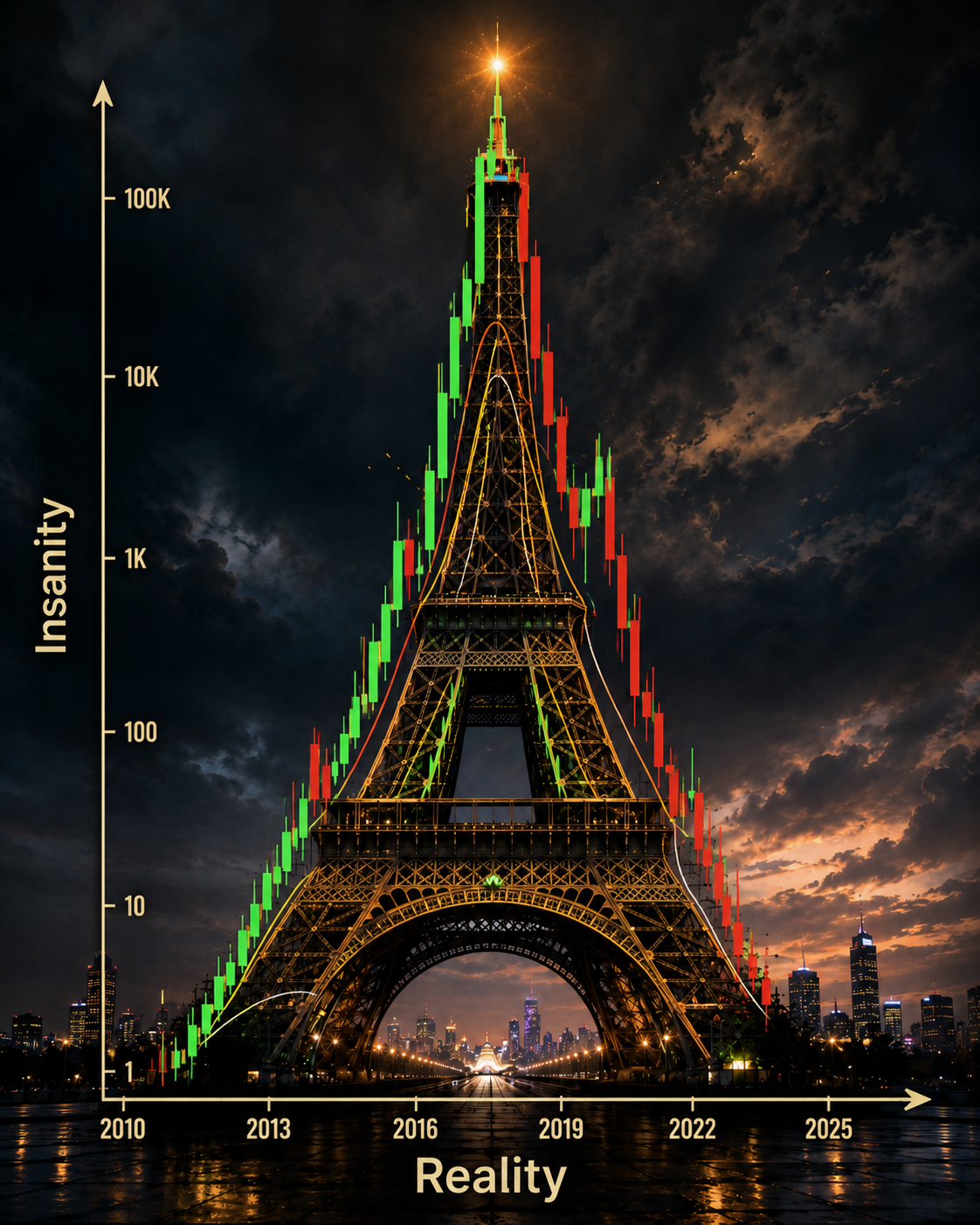
Do not chase FOMO. That's the dirty devil of envy stirring in your gut. And it's a lie.
Do not be boring either. Be aggressive where you have an edge. Be disciplined where you do not. Build wealth through the things you can influence. Protect wealth from the things you cannot predict. There is a massive difference between taking risks and chasing noise.
Sound advice is not about finding the highest possible return in a vacuum. It is about finding the highest likelihood of success with the highest potential return. That combination wins versus chasing the moonshot 99 out of 100 times.