

The yield on the 30-year Treasury reached 5.31% on August 17, the highest level since 2007.¹ Germany's long rates sit near 2011 levels, and Canada's 30-year is at its highest since 2010.² Japan's 10-year touched 2.95%, a level last seen in 1996.³ When long-dated government bonds reprice in every major market at once, the explanation usually is not any single government's budget.
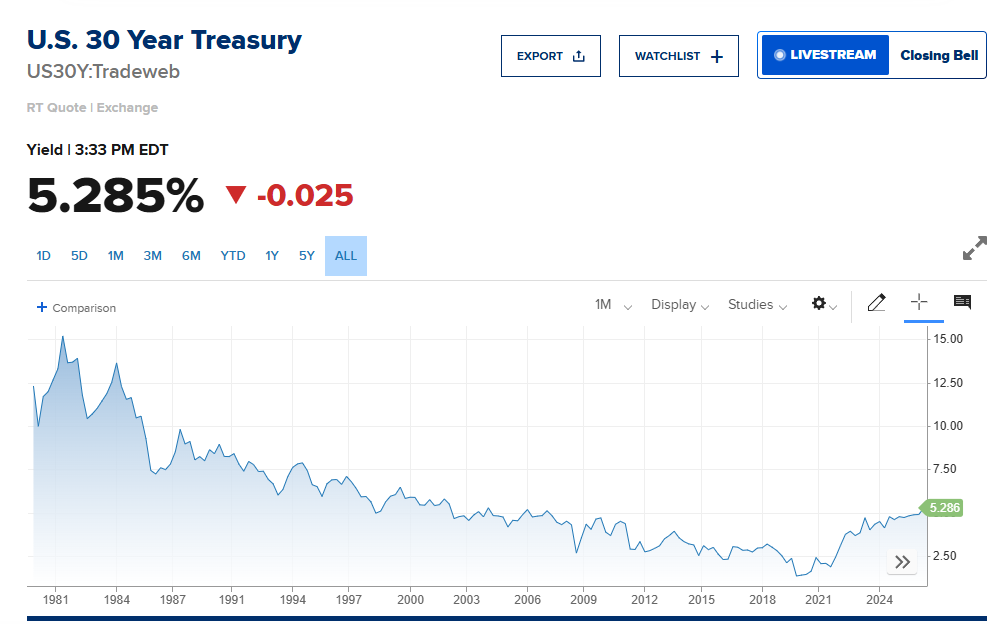
Two things changed on the demand side.
For roughly 15 years, the largest buyers of long-dated government debt were not price-sensitive. Central banks purchased through quantitative easing. Japanese institutions bought overseas because domestic yields paid nothing. Both have stepped back. Japanese investors sold $29.6 billion of U.S. debt in the first quarter of 2026 as yields at home became competitive.⁴ Foreign holdings of Treasuries declined again in June, with the United Kingdom, China, and Japan all reducing positions.⁵
The second change is more recent. The Treasury now competes for long-duration capital against corporate issuers. The five largest hyperscalers issued approximately $121 billion of U.S. corporate bonds in 2025, against a $28 billion annual average from 2020 through 2024.⁶ Alphabet recently placed 30-year paper at a yield near 6.4%.⁷ Bank of America economists estimate that corporate and mortgage-backed supply added roughly 0.3 percentage points to the 10-year yield this year.⁸
Supply did not shrink. The marginal buyer became someone who requires compensation to hold duration.
Now most of the portfolios we review are equity-heavy, and this makes sense. Higher yields don’t necessarily mean equities decline. Equities have delivered acceptable results in higher-rate periods when nominal growth was also higher. Two important observations:
1) Long Treasuries may not offset equity losses
2) Equity and fixed income sleeves may not provide independent exposures
When inflation is the primary driver of rates, both have tended to move together.
The question we work through with clients is not where the 30-year trades next quarter. It is whether each sleeve of the portfolio is doing the job it was assigned.
Sources
1. Bloomberg, "US Bond Selloff Drives 30-Year Yields to Highest Since 2007," August 17, 2026.
2. Bloomberg, August 17, 2026.
3. Trading Economics, Japan 10-Year Government Bond Yield, over-the-counter interbank quotes, August 18, 2026.
4. Federated Hermes commentary, reported by CNBC, July 14, 2026.
5. U.S. Department of the Treasury, Treasury International Capital data for June 2026, reported by CNBC, August 18, 2026.
6. BofA Securities report dated January 9, 2026, reported by Reuters, January 15, 2026.
7. Bloomberg, August 17, 2026.
8. BofA Global Research client note, reported by Bloomberg, August 2026.
Disclosures
Yield and valuation figures are as of the dates noted and change continuously. Figures cited from third-party sources have not been independently verified by AFE Private Wealth.
Advisory services provided by NewEdge Advisors, LLC doing business as AFE Private Wealth, as a registered investment adviser.
**Not Investment Advice / No Solicitation.** This document is for informational purposes only and does not constitute investment advice, a solicitation, or an offer to buy or sell any security. The information contained herein is based on sources believed to be reliable but is not guaranteed to be accurate or complete. Opinions expressed are those of AFE Private Wealth as of the date of this document and are subject to change without notice. Nothing in this document should be construed as a recommendation to buy, sell, or hold any specific security or investment product. Clients should consult with their AFE advisor before making any investment decisions.
**RIA Registration and Fiduciary Duty.** Advisory services are offered through NewEdge Advisors, LLC, doing business as AFE Private Wealth, a registered investment adviser. Registration with the Securities and Exchange Commission does not imply a certain level of skill or training. A copy of NewEdge Advisors' current written disclosure document discussing our advisory services, fees, and conflicts of interest (Form ADV Parts 2A and 2B) is available upon request or at www.adviserinfo.sec.gov. Clients are encouraged to review this document carefully before engaging advisory services.
AFE Private Wealth acts in a fiduciary capacity with respect to the investment advisory services provided to its clients. As a fiduciary, AFE Private Wealth is obligated to act in the best interest of its clients at all times. This document is prepared in good faith based on the client's stated financial circumstances, risk tolerance, and investment objectives as communicated to the advisor. No advice may be rendered unless a client service agreement is in place.
**NewEdge Advisors Network Compliance.** AFE Private Wealth operates as an independent entity within the NewEdge Advisors network. Advisory services are offered through NewEdge Advisors, LLC, doing business as AFE Private Wealth, a registered investment adviser. Recommendations and materials produced by AFE Private Wealth are subject to the compliance policies, supervisory procedures, and oversight protocols established by NewEdge Advisors, LLC. Clients with questions regarding the supervisory structure of their advisory relationship may contact AFE Private Wealth directly or reach NewEdge Advisors at their principal office.
**Investment Risk.** All investments involve risk, including the potential loss of principal. Equity investments are subject to market risk, economic conditions, and issuer-specific factors that may cause the value of investments to fluctuate. Fixed income investments are subject to interest rate risk, credit risk, and inflation risk. International investing involves additional risks, including currency fluctuations, political instability, differing accounting standards, and potentially limited liquidity. Small-cap and mid-cap investments tend to be more volatile than large-cap investments and may be subject to greater liquidity risk. Alternative investments may involve complex structures, limited liquidity, and higher fees. Past performance is not indicative of future results. There is no guarantee that any investment strategy will achieve its objectives.
**Forward-Looking Statements.** Certain statements in this document constitute forward-looking statements, including projections, price targets, return estimates, and scenario analyses. Forward-looking statements are based on assumptions and estimates that, while considered reasonable at the time of preparation, are inherently uncertain and subject to change. Actual results may differ materially from those projected due to changes in market conditions, economic factors, interest rates, regulatory environment, geopolitical developments, or other factors beyond AFE Private Wealth's control. Forward-looking statements should not be relied upon as predictions of future events. AFE Private Wealth undertakes no obligation to update forward-looking statements to reflect events or circumstances after the date of this document.
**Third-Party Data Attribution.** Certain data, statistics, and information presented in this document have been obtained from third-party sources believed to be reliable, including Bloomberg, Reuters, CNBC, FactSet, PIMCO, Apollo Global Management, Breckinridge Capital Advisors, WisdomTree, BofA Securities, Trading Economics, and the U.S. Department of the Treasury. AFE Private Wealth has not independently verified all third-party data and makes no representation or warranty as to its accuracy or completeness. Third-party data is subject to change without notice. AFE Private Wealth is not responsible for errors or omissions in third-party data. Any analysis based on third-party data should be considered in light of these limitations.
Not FDIC Insured | No Bank Guarantee | May Lose Value