

Every so often, a technological shift emerges that has the potential to fundamentally reshape the economy. Artificial intelligence may be one of those moments. The image below highlights the extraordinary growth in AI capabilities over the last 18 months. Less than two years ago, an AI model could perform roughly six minutes of human labor almost instantaneously. Today, that number is more than sixty minutes, a tenfold increase in less than two years.
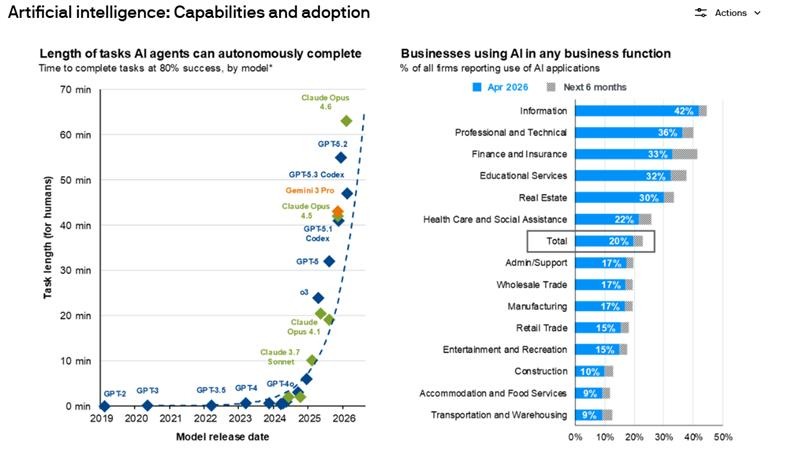
Source: J.P. Morgan Guide to the Markets
That is a remarkable number. If you begin to extrapolate that kind of productivity improvement across industries, sectors, and businesses, it becomes easier to understand why investors are so bullish about what AI implementation could mean for economic growth, corporate profitability, and business valuations.
Of course, there will be hiccups along the way. Building AI data centers is much easier on an Excel spreadsheet than it is in the real world. Community opposition, power availability, permitting delays, component supply, and countless other practical constraints will likely make implementation uneven and choppy. But that does not change the larger point, as AI functionality becomes embedded throughout the economy, its impact will represent one of the most significant innovations in human history.
The functionality will touch nearly every area of economic activity. Predication tools may allow companies to forecast demand with a level of precision that makes one-hour availability of many products far more realistic. Processing tools could accelerate pharmaceutical development at unprecedented speeds. Software development will increasingly become available to people with little or no coding background. Statistical analysis, once limited to highly trained specialists and expensive systems, will be broadly accessible and processed at speeds that were previously unimaginable.
We believe these innovations may presage a golden era for global business. The ability to drive innovation, efficiency, and growth at lower cost should be meaningfully accretive to margins and earnings. And higher margins and earnings, in turn, can support higher valuation multiples.
The path will not be a straight line. There will be excesses, disappointments, delays, and volatility. But if we can step back from the day-to-day noise and focus on what AI innovation is likely to bring over the coming years, it is difficult not to be optimistic about the outlook for the global economy.